
Which Court Documents Should You Review Before Bidding at a Foreclosure Auction?
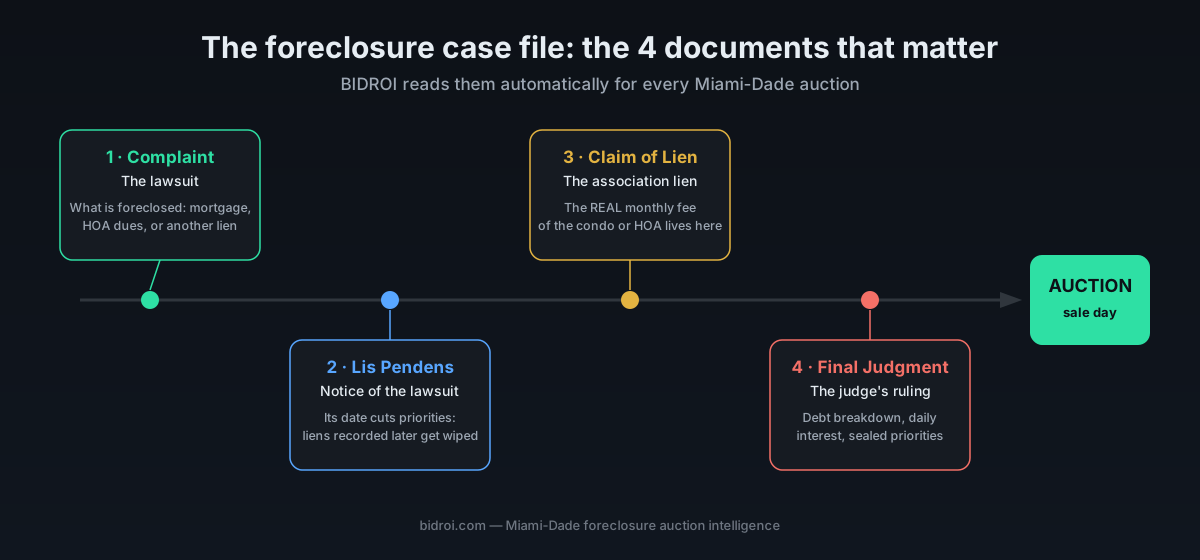
Before bidding at a Miami-Dade foreclosure auction, there are four court documents in the case file you need to understand: the complaint (the lawsuit), the lis pendens (the notice of the lawsuit), the Claim of Lien (the association lien, when a condo or HOA is foreclosing) and the Final Judgment (the judge's final ruling). Together they answer the three questions that decide whether an auction is a deal or a trap: what is being foreclosed, which debts get wiped by the sale, and which debts the buyer inherits. BIDROI now reads all four documents automatically for every auction and shows you where each data point comes from.
What is the complaint and what does it tell you?
The complaint is the lawsuit — the document that starts every foreclosure. In it, the plaintiff states what is being foreclosed (a mortgage, unpaid association dues, a contractor's lien) and against whom.
That "what" is the most valuable piece of information in the entire case file, because the type of foreclosure defines what you inherit. If the first-mortgage bank is foreclosing, the main debt gets paid from the sale. If a condo association is foreclosing over unpaid dues, the bank's mortgage does not go away — the buyer inherits it in full. You can read more about that difference in our guide to HOA foreclosures vs bank foreclosures.
One detail that confuses many beginners: the plaintiff's name alone cannot tell you what kind of case it is. There are lenders with "Association" in their name (like Federal National Mortgage Association) and associations with names that look like companies. The only reliable way to know is to read the counts of the complaint — "Count I" — and the statutes it cites.
What is the lis pendens and why does its date matter?
Lis pendens is Latin for "pending litigation." It is the notice the plaintiff records in the county's official records when the lawsuit starts, announcing that the property is in dispute.
Its date works as a priority cut-off line. Under Florida law (Statute 48.23), interests recorded after the lis pendens are bound by the outcome of the case: if the foreclosure ends in a sale, those later liens are generally extinguished. Interests recorded before it can survive and pass to the buyer.
In practice: a judgment lien that a creditor recorded six months after the lis pendens will almost certainly disappear with the sale. A second mortgage recorded years earlier is a different story — it can survive if it was not included in the case. Our guide on which liens survive a foreclosure auction goes deeper.
What is the Claim of Lien and where is the association's real monthly fee?
When a condo or HOA sues over unpaid dues (under Florida Statutes 718.116 and 720.3085), it first records a Claim of Lien: the document detailing the debt being claimed.
That document hides a data point almost nobody looks at, and it changes the whole analysis: the association's real periodic assessment — not the accumulated debt, but the monthly fee the new owner will pay every month. In Miami-Dade we have read fees ranging from $86 to $1,599 per month in active auctions. The difference between estimating that fee and knowing it can move thousands of dollars a year in true carrying costs — and with them, your margin.
If you are wondering whether the accumulated HOA debt passes to the buyer, we have a direct answer in does HOA debt survive the foreclosure auction?
What is the Final Judgment and why is it the document that rules?
The Final Judgment is the judge's final ruling: the document that closes the case, sets the total debt and orders the auction. It is the difference between what the plaintiff alleges (the complaint) and what the court decided.
Three valuable things live in it:
- The debt breakdown. Not just the total: how much is principal, how much accrued interest, how much fees and advances. A judgment where interest exceeds principal tells the story of years of delinquency — and a property that spent years without an owner caring for it usually needs more repair.
- The per diem interest. The judgment keeps growing every day until the sale. On an auction that gets rescheduled for months, that can add tens of thousands of dollars on top of the published figure.
- Priorities with a judicial seal. The judge frequently declares which co-defendants' interests are extinguished and which are superior. It is the strongest priority ruling that exists short of a title search — because it is not an inference: a judge signed it.
How does BIDROI read these documents for you?
Reading a court file takes time: locating each document in the Clerk's system, downloading it, deciphering scans and legal language. Multiply that by dozens of weekly auctions and it becomes impossible for an individual investor.
That is why BIDROI now does it automatically, every day, for every active Miami-Dade auction: